


A Digital Giant at the Forest’s Doorstep

What Belém’s New Data Center Means for Pará
eyesonbrasil
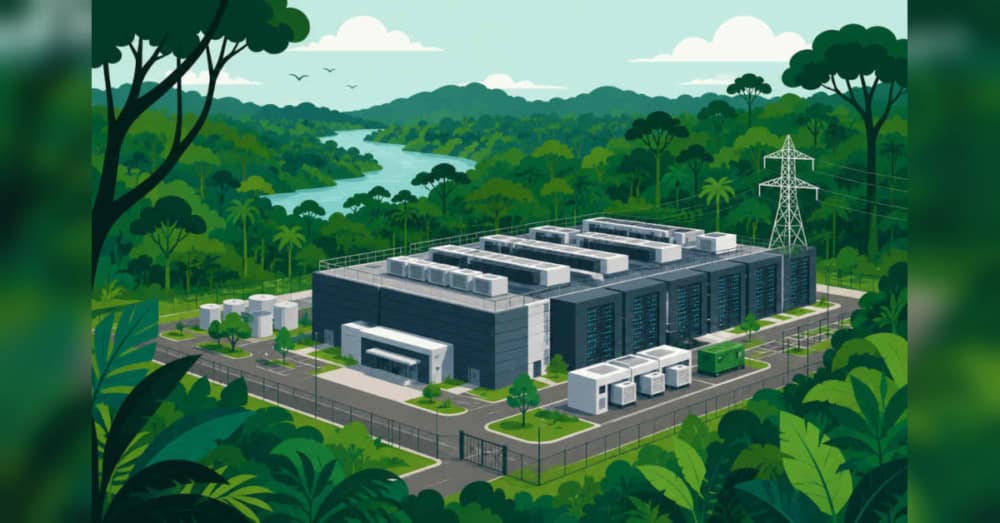
On the outskirts of Belém, a quiet construction site is about to become one of the most contradictory symbols of Brazil’s new digital economy. Elea Data Centers, in partnership with the energy supplier AXIA, has announced BEL1: the Amazon’s first major data center built for artificial intelligence workloads, rising near the Miramar Substation, with an initial investment of R$250 million (roughly $45 million), a starting capacity of 7.5 megawatts, and a planned launch as early as the second quarter of 2027. Under the company’s plans, the facility could expand in stages to as much as 100 megawatts — enough to power a mid-sized city, except this one is dedicated to servers.
For many people in Belém, the news landed as a mix of pride and unease. Just after hosting COP30, Pará’s capital now finds itself courted by the most energy- and water-hungry industry in the digital world — at the very moment when the region’s rivers still carry the memory of two of the worst droughts ever recorded in the Amazon, in 2023 and 2024, and when heat is already, for many residents, a constant and oppressive presence.
The upside: infrastructure, jobs, and a seat at the AI table
Supporters of the project point to advantages that go beyond the obvious promise of “creating jobs.” The arrival of a state-of-the-art data center could:
- Reduce the region’s tech dependence on the Southeast. Today, universities, businesses, and public agencies in Pará rely on servers located thousands of miles away. Local processing power would mean lower latency, lower costs, and greater digital autonomy for the region.
- Tap into a genuine energy advantage. Pará has a strong clean-energy mix and an electrical grid that’s expanding, which in theory allows the facility to be powered without necessarily competing with residential consumption — provided the additional power is actually generated specifically for that purpose, as happened with similar projects in Ceará, where new wind farms were built exclusively to supply data centers.
- Seed a broader innovation ecosystem. International experience shows that large data centers tend to attract software companies, cloud providers, telecom operators, and startups around them — a ripple effect that could help establish Belém as the Amazon’s technology hub, especially with the connectivity boost from the Norte Conectado program and alternative international submarine cable routes.
- Build a skilled local workforce. The project could push local universities — the Federal University of Pará (UFPA) already runs a high-performance computing and AI research center — to expand technical and technology courses, training engineers, network specialists, and cybersecurity professionals locally, rather than exporting that talent to Brazil’s South and Southeast.
- Generate revenue and extend COP30’s legacy. The urban and digital infrastructure investments left behind by the climate conference have already raised the city’s connectivity standards; the data center could be the natural next step, drawing billions in private capital to a region historically starved of major tech investment.
The downside: heat, water, and a bill the forest may end up paying
But this is exactly where the tension lies. A large-scale data center isn’t just another factory — it’s essentially a giant machine for converting electricity into heat, and it needs robust systems, often water-based, to dissipate that heat around the clock, every day of the year.
- The region is already at a climate breaking point. Between 2023 and 2024, the Amazon experienced its two worst droughts on record, with rivers hitting their lowest levels in more than a century of monitoring in some stretches, isolated communities, and millions of dead fish. While 2025 brought some relative relief, scientists studying these droughts have linked them directly to global warming, warning that every fraction of a degree of additional heating raises the risk of new extreme episodes — regardless of natural cycles like El Niño.
- Adding heat where heat is already a burden. Installing an additional, constant source of waste heat in a city that already endures extreme temperatures raises a legitimate question: even with modern cooling systems, what is the cumulative effect of dozens of megawatts of dissipated heat, year after year, in a tropical urban area?
- The fight over water is real elsewhere. In similar projects in Ceará, the promise of closed-loop cooling systems — which reduce but don’t eliminate water use — became a matter of public debate, to the point that Brazil’s president publicly asked a company to guarantee the use of reclaimed water and renewable energy before moving forward. That shows guarantees of “low water consumption” depend entirely on the specific technology adopted and on rigorous enforcement of the commitments made — they aren’t automatic.
- The energy math may not be as neutral as it sounds. Even when power comes from dedicated renewable sources, expanding a region’s electrical infrastructure carries its own costs and impacts — new transmission lines, substations, and pressure on the local grid, especially if the data center’s growth (from 7.5 MW to as much as 100 MW) outpaces the buildout of additional generation.
- Concentrated benefits, diffuse risks. Data centers are highly automated and employ relatively few people to operate, compared with the scale of investment involved. The environmental risk — heat, water strain, pressure on the power grid — tends to be felt by the entire population, while the profits and much of the skilled employment may be concentrated in relatively few hands, at least in the early years.
The question that remains
None of these concerns necessarily means the project should be rejected — but they also shouldn’t be treated as technical details to sort out after the ribbon-cutting. Whether BEL1 becomes a symbol of sustainable development or another chapter of predatory extraction in the Amazon hinges on concrete decisions that are still open: which cooling technology will actually be used, where each additional megawatt of power will come from, what contractual guarantees will protect the population’s water supply during drought years, and what transparency mechanisms will let the people of Pará monitor these promises over time — rather than simply trust them.
Belém isn’t just gaining a data center. Over the coming months, it’s deciding what kind of precedent it wants to set for the arrival of the AI economy in the Amazon: one that respects the limits of an already-stressed ecosystem, or one that repeats, with servers instead of timber and minerals, the old pattern of extracting benefits in one place and exporting the profits somewhere else.
Sources: reporting from Ver-o-Fato, InfoPebas, TeleSíntese, Agência Brasil, InfoAmazonia, Observatório do Clima, and Congresso em Foco (2025–2026).